Live video for footbal lover from Carlsberg Web-TV channel

posted under by movie lover
Are you a footbal manic? Which team do you like? Now you can play the video clips about football funnies and rituals from the Football Magic channel or the bizarre story about fans in the stand and how fan culture sometimes go beyond reason.


Ya, just go to partofthegame.tv to watch those cool live video from Carlsberg Web-TV channel. This web-tv has just been released by Carlsberg. They launched 5 channels showing all aspects about football from the classic football matches to life as a fan. You can also upload your own favourite football and fan moments. for more information please visit www.partofthegame.tv

Comedy of Power

posted under by movie lover
This conversation really happened:

"What movie did you just see?"

"Comedy of Power."

"Oh, was it funny?"

"Yeah, it was a light comedy."

"Was it a romantic comedy?"

"No, it was about a judge, sort of like we have district attorneys, who's assigned to investigate a massively corrupt company kind of like Enron, and how it fucks up her life."

"..."

"Light comedies are different in France."

Claude Chabrol invented the nouvelle vague, and if he'd never done anything else with his career ever, that would leave me eternally in his debt. He's more or less the Hitchcock of France, and his best films are all mysteries, at least nominally. L'ivresse du pouvoir is not a mystery.

That is not the same as "it's bad," but it's not really all that good. Isabelle Huppert, one of the truly great actresses of French cinema, plays Jeanne Charmant-Killman, a district judge investigating the indiscretions of Michel Humeau (François Berléand), the chairman of an unnamed company, which in some indeterminate fashion controls the financial fates of several other companies and apparently some small countries. In other words, Enron. A title card opens the film, assuring us that it is a work of fiction, but this is only partially true: it is in fact based on a French scandal very much like our own in which a company responsible for the financial fates of other companies was found to be ridden with corruption at all levels of management.

The problem with "ripped from the headlines" films is that they don't have a whole lot of traction if you don't know the headline (it takes a truly mythic story such as All the President's Men to overcome this). Which both is and isn't Chabrol's problem: he can't be blamed for my ignorance, but he should be able to give me something interesting to keep my attention when the story founders. In the case of his New Wave stablemates (especially Jean-Luc Godard), story was usually the least important element of filmmaking, anyway; and while Chabrol has always been a bit more of a storyteller, he's traditionally been able to create compelling atmosphere and characters.

That doesn't really happen, here. Jeanne is interesting - how could she not be, with Huppert playing her? - but what happens to her generally isn't. Her jealous and lonely husband isn't in the film enough to register, and people drift in and out of her professional world at intervals too erratic to make much of an emotional punch. The plot picks up a bit at the end, and Jeanne undergoes some actual crisis, but for the bulk of the film she is simply too competent and too in control for the movie's own good: it never seems remotely credible that she will not eventually emerge victorious through her dogged perseverance. There is no conflict because there is no tension.

There are, however, some genuinely pleasing set-pieces. Jeanne is a genius, and there is fun to be had in watching her effortlessly trap the venal executives who parade in front of her desk. And most of those executives are amusingly drawn, although often they are too broad to work effectively as satire. It's a feel-good comedy, essentially; and who the hell wants to feel good watching a French film? [http://antagonie.blogspot.com]

All the King's Men

posted under by movie lover
Lend me your ears: I come neither to bury All the King's Men nor to praise it. Forget what you've heard: this is not a trainwreck of a film, it is not the most bloated and hackneyed film of 2006, it is not an incoherent film with no t a trace of political knowledge. It is perfectly functional, and is made with workmanlike efficiency. How's that for damning with faint praise?

To be fair, there is one glaring point on which the film is not merely bad but excruciating, and it's probably the film's most notable aspect, and that is Sean Justin Penn. I have not seen all of his performances, and therefore it's not for me to judge this his "worst"; but I want to so very, very badly.

As everyone in America knows, and has been ever since the movie was delayed from last November (more on that shortly), Penn plays Willie Stark in this second filmed adaptation of Robert Warren's novel. The story is familiar to anyone who ever heard of American literature, or of populist firebrand Huey Long: Stark rises from the rural backwaters of Louisiana to become governor on an idealistic far-left platform, only to allow his perfect political machine devolve into a mire of corruption when it becomes clear that there is no other way to achieve his goals.

Stark is larger than life, a man of such imposing presence that you cannot possibly ignore him. Penn, for all his intensity as a performer, is not physically imposing. In the 1949 adaptation of the novel, Broderick Crawford has presence just from standing still. Penn is a slight man, even with a ridiculous little padded gut, and to make up for it, he acts...

No, I take that back. He doesn't act. Acting requires knowledge about the choices one makes, and it really doesn't seem that Penn has any such knowledge. He's channelling all of the things he can to seem powerful and charismatic, but it turns out very poorly.

The scene that will stick with me for the rest of my life is his first major speech. To this point, Stark has been the unknowing puppet of the Powers That Be, and he claims his independence in a frank, angry moment of passion on stage in front of those he lovingly calls "hicks." To show this passion - the charisma and power that bring all those poor folks to stand in his presence - Penn windmills his arms around in opposing circles.

You may reread that clause. I'll wait. It won't change, though.

So, yes: to embody the most charming and persuasive speaker in Louisiana history, Sean Penn waves his arms around like he's in a dance on Sesame Street, while speaking with a psychotic cartoon accent that consists largely of replacing his th's with d's and t's, and never pronouncing the final consonant of a word. He flails like an electroshock patient at every major emotional moment, and the less said about his hair (which, in fairness, is probably not his fault), the better. Willie Stark does not seem like a great governor - he doesn't really seem like a human being, more like a Disneyland animatronic that hasn't been fully programmed yet.

The good news is that Penn isn't actually the main character in the film. That would be Jude Law's Jack Burden, the journalist turned Stark hanger-on who narrates the film from about 3/5 of the way through it, although he continues to narrate right 'til the end. Law is not nearly as bad as Penn, though he is far from his best work: much like the rest of the cast, his performance revolves around his accent, but unlike everyone but Penn, his accent doesn't work. Not that it's bad: just that it's not always present. When Burden turns investigator in the middle of the film, and thence becomes the focus of the story, it becomes clear that Law doesn't want to play a venal character (which he must), and the film scuttles itself, although this falsely implies that the film had been sailing smoothly up to this point.

It's pretty easy to dismiss everyone else as wildly overqualified: Anthony Hopkins is actually better than he has been in a while, but a number of powerful actors - Patricia Clarkson, Kate Winslet, James Gandolfini, Mark Ruffalo - fail to make any impression at all (although Gandolfini hints at how much better he would have been as Stark). Frankly, Penn steals most of the energy away from the rest of the film - he may be a babbling and incoherent slab of overcooked ham, but he's impossible to ignore for precisely that reason.

It doesn't help the actors that the film is written and directed by Steven Zaillian, whose only connection to quality filmmaking is the screenplay to Schindler's List, and watching this flaccid epic of political morality, it's easy to wonder if that film was so well written after all (behold the power of a great director). It's not that he's a hack, exactly - this seems like a personal project, and you can't fault it for lack of ambition - and it's not that he's bad, exactly - there aren't really any wrong choices made. He's just very, very uncreative. The film is very cramped, not because it should be, but because Zaillian and cinematographer Pawel Edelman (who really should know better: he's worked with Polanski and Wajda, for God's sakes) don't seem to understand how to suggest that there is a world outside of the frame. Characters are uncomfortably stuffed into boxlike shots that we've all seen hundreds of times, often in the first projects of film students. Every conversation - and this is a film made up almost solely of conversations - follows the same pattern of showing the chest and head of whomever is speaking, sometimes if we're very lucky including the other person as a framing element.

When the film was pulled, the official reason was that the score and editing weren't complete. If that's true, it's kind of justified: the editing works very well in that "don't call attention to the editing" way, although I doubt that they needed to cut every time a new person spoke. The score is a different matter entirely: as composed by professionally awful composer James Horner, it is the aural equivalent of Penn's acting: cartoonishly bombastic and disgusting. Horner uses the timpani the way that sane composers use the violin or trumpet, and rather than excite and stir the emotions, it turns the entire film into a literally thudding assault on the ear, and then through the ear right into your brain, where it feels like the timpani is lodged securely in your frontal lobe.

As for the politics...I hesitate to bring them up at all. As produced by James Carville, this is obviously meant to be a defense of extremism in the pursuit of progressivism, and I'm for that. But it's so unengaging and sleepy that I can't really bring myself to care. And besides, one terrible choice ruins the whole political angle anyway: as originally set in the '20s and '30s, the story made sense: that was the last great period of radical leftism in America. For a reason that defies rationality, Zaillian has reset it to the 1950s. The idea of someone like Stark rising to power in the Eisenhower years cannot be imagined, and it turns the film from a wistful dream to an outright lunatic fantasy. It's juuuust possible to romanticise the politcal machines of the Depression, but corruption after WWII has a much different, less poetic flavor.

Still, it could have been worse. It frankly should have been worse, and I feel a bit cheated. I wanted All the King's Men to be a miscalculation of operatic proportions, but it's far more depressing than that: it is almost totally competent.[http://antagonie.blogspot.com]

"Big Bang" - Master List-1

posted under by movie lover
"Big Bang" -Master List is a group that intended to participate in another adventure in terms of Technorati authority. This will help you increase your authority link in technoraty, boost your traffic. For me, this is a kind of social blogging activities since one blogger help other to reach the same goal.

If you are interested in watching your authority grow, then just follow the simple rules below. Anyone can play so just have fun. Join "Big Bang" -Master List


You do not have to be tagged to play along. This game is simple and so are the rules.

1. Copy from *Start Copy Here* through *End Copy Here*
2. Add your site(s) to the list. Just be sure to post at each site you add.
3. Tag or don’t tag, your choice, however, the more tags you create the bigger the list will grow.
4. Let me know your blog’s name and url by leaving me a comment HERE. I will add you to the master list. (If you would like the scroll box code, leave me your email address and I will email it to you.)
5. Come back and copy the master list back to your site, often. This process will allow late-comers to get as much link benefit as the first ones in.


1-Attitude, the Ultimate Power 2-Juliana's Site 3-Rusin Roundup 4-Grow Rich Along With Me 5-Comedy Plus 6-lynda's loft 7-Amel's Realm 8-MAX 9-Speedcat Hollydale 10-Mariuca 11-Complain Complain Complain 12-Mariuca's Perfume Gallery 13-Life Is A Roller Coaster 14-Sugar Queen's Dream 15-First Time Dad 16-Life 17-My Life 18-The Painted Veil 19-My Thoughts 20-DatCurious.com 21-Little Aussie Cynic 22-A Nice Place in the Sun 23-DatMoney.com 24-The Down Side OF Up 25-Ladyjava's Lounge 26-Cat Tales 27-moms.....check nyo 28-Colorado Baby 29-It's a Woman's World 30-ENLIGHTENED BITS 31-My View of "It" 32-My Reviews and Finds Along the Way 33-Our Hep Chat 34-Rantings of a Woman 35-The Callalily Space 36-Mom Knows Everything 37-Hazel 38- Chronicles and Tales Unlimited (RED) 39-From the Mouth of Jabber Jaws 40-Sunny Side Up Foodie & Lifestyle 41-Carmel Corn 42-Daily Stock Picks 43-The Whole New World 44-Wifespeak 45-Slavery Bliss 46-Rooms of My Heart 47-Unpredictable Life 48-My Life, My World 49- At Your Service 50-All About Ebay 51-Everything Amazon 52-Turn On, Tune In, Drop Out 53-My So-Called Site 54-New Wife Blog 55-Tendre Poison 323 56-Nick's Bytes 57-My Scratch Pad 58-Choc Mint Girl 59-Life Is Just Around the Corner... 60-Amori, poseia, art... virtuali by Hanna 61-Maryannaville 62-monaco - monaco's 63-Nyumix's Blog 64-read my mind - my keyboard monologues 65-Shower You Children With Love - The Right Way 66-Secret Agent Mama 67-Pinaymama's Diary 68-Answers to the Questions 69-Work of the Poet 70-A Total Blog 71-My life, my hope, my future 72-NORTE 73-A Window to Our World 74-Life as a Mom 75-FIELD OF DREAMS 76-lisgold 77-See Me for What You 78-Caught in The Stream 79-Pinay Mommy Online - My Home 80-I'm Running To Win Two 81-CRUEL VIRGIN 82-Garden of Moments in Blog 83-So Cute 84-Love Everlasting 85-WeLcOmE To My CriB 86-WELCOM TO PINAYSMILE'S JOURNEY 87-Ice's Icelog 88-Jenny's Wandering Thoughts 89-Hobbies ans Such 90-Sweet Paradise 91-Mommy's Gibble Gabbles 92-Rusin Review's 93-My Small World 94-Little Peanut 95-Online Ramblings 96-My Mood My Feeling 97-BLOG it with ALLEN 98-Entertainment World 99-Let's Go Singapore 100-Firelynx 101-Catsy Carpe Diem 102-Every Beat Of My Heart 103-Always Da Fresh Princess 104-Listening.. Learning..Living 105-All About Mars 106-Syii From Afar 107-Some Thoughts I Have 108-From Here and Beyond 109-My Paid To Blog 110-Scholarship Corner 111-Cell Phone Review 112-"Apples of the Eyes" 113-It's All About Play 114-The Luttrull Journey 115-RennyBA's Terella 116-Unchained Melody 117-Out of the Blue 118-The Lure Of the Unknown 119-Maricel's 120-my blog 121-Spiff, the Spaceman 122-Living Well 123-The Dog Log 124-Catnip Corner 125-A Piece of Idea 126-Observations From the Back 40 127-Poetry by The Redneck Gypsy 128-Odd Facts 129-Juliana's Lair 130-My life is murphy's law 131-lisgoldsmemoirs 132-My memories, as time goes by 133-Somewhere over the rainbow 134-Blogging by Sandee 135-Our Journey to this so called life 136-Idaho Daily Photo 137-Memories that Never Fades.. 138-Anything goes 139-Your Caring Angels 140-Little Paces 141-Laketrees 142-PoeARTica 143-fracas 144-Just FraCas 145-Archies Archive 146-Growing Up Together 147-A Woman's Diary 148-Mother's Got A Dot Com 149-Close To You 150-Hot Shit Form Here 151-Astro Galaxy 152-Detector 153-

*End Copy Here


I tag for : Comedy Plus - Life - Movie Corner - Greatest Literary Works - Successful Dating Tips - Review Bisnis Internet - Paypal Indonesia - Rahasia Bisnis Internet - Scholarship Info - Funponsel - Free Ringtones - PPC vs PTR - Bali Hotel - Make Money from Blogging - Singapore Tour - MLM - Forex Trading - Marketiva - Adsense Success Stories 2008 - Hanna - Colorado Baby - Lisa - Lolli - Norm - Paula- Angelbaby - Carol - Shoshana Rose -Chris - Francine - Joy - Mary Ann - Claudette - Jeremy - RennyBA

The Lord of the Rings: The Return of the King (2003 Film)

posted under by movie lover
The Lord of the Rings: The Return of the King is an epic fantasy film directed by Peter Jackson. It is primarily based on the third volume of J. R. R. Tolkien's The Lord of the Rings (but also includes material from the second volume), and it is the concluding film in The Lord of the Rings film trilogy. It follows The Fellowship of the Ring and The Two Towers and was filmed simultaneously with them.

As Sauron launches the final stages of his conquest of Middle-earth, Gandalf the Wizard and Théoden King of Rohan step up their forces to help defend Gondor's capital Minas Tirith from this threat. Aragorn must finally take up the throne of Gondor and summons an army of ghosts to help him defeat Sauron. Ultimately, even with full strength of arms, they find they cannot win; it comes down to the Hobbits Frodo and Sam, who themselves face the burden of the Ring and the treachery of Gollum, to destroy the One Ring in Mordor.

Released on December 17, 2003, The Lord of the Rings: The Return of the King became one of the most critically acclaimed films and greatest box-office successes of all time. It swept all eleven Academy Awards it was nominated for, which ties it with only Titanic and Ben-Hur for most Academy Awards ever won. It also won the Academy Award for Best Picture, the only time in history a fantasy film has done so. It also became the second highest grossing movie worldwide of all time behind Titanic, unadjusted for inflation.The Special Extended Edition, containing 50 more minutes of footage, was released on DVD on December 14, 2004.

Comparison with the source material

The film contains major scenes that occurred in the middle portion of the novel The Lord of the Rings: The Two Towers but were not included in the film The Lord of the Rings: The Two Towers, such as Shelob and the palantír subplot, due to Jackson realigning the timeline as described in the book's Appendices, but not in the main prose. Saruman's murder by Gríma (seen only in the Extended Edition) is moved into the Isengard visit due to the cutting of the Scouring of the Shire. In the movie, Saruman drops the palantír, whereas in the book Gríma throws it at the Fellowship, unaware of its value. The entire Shelob sequence also takes place at the end of The Two Towers book, rather than within The Return of the King book.

Denethor, the Steward of Gondor was a more tragic character in the book. The film only focuses on his overwhelming grief over the death of Boromir as to ignore Sauron's threat (in the book he already lights the beacons), and is driven over the edge by Faramir's injury. The film only hints at his use of the palantír which drives him mad, information revealed in the Pyre scene, which is more violent than the book. Jackson also has Denethor jump off the Citadel instead of burning himself on the Pyre, one of the earliest changes.

The Battle of the Pelennor Fields is altered: Faramir never goes on a suicide mission, and is a simplification of the siege of Osgiliath. Generals such as Forlong and Imrahil are also absent, only leaving Gandalf in command. The Orcs also never get into the city in the book. The Witch-king enters and stands off against Gandalf before the Rohirrim arrive, but in the film Orcs invade the city after Grond breaks the Gate. The confrontation takes place whilst Gandalf journeys to save Faramir in the Extended Edition, during which Gandalf has his staff broken. A subplot in which the Rohirrim are aided by the primitive Drúedain into entering the besieged Gondor is also excised. Éowyn's presence to the reader on the battlefield is unknown until she takes off her helmet, but in the film the audience is aware, due to the difference of film and book as a medium.[9] When hope is almost lost, Gandalf also comforts Pippin with a description of the Undying Lands, which is a descriptive passage in the book's final chapter.

Sam and Frodo's major rift in their friendship, due to Gollum's machinations, never takes place in the book, but the writers added it because it added drama and more complexity to Frodo. Frodo enters Shelob's lair alone in the movie, whereas in the book he and Sam entered together. This was done to make the scene more horrific with Frodo being alone, and Sam's rescue at the last minute more dramatic. Also, in the movie we don't know that Sam has the ring until he gives it back to Frodo, whereas in the book the reader knows that Sam has the ring. Gollum's fall into the lava of Mount Doom was also rewritten for the film, as the writers felt Tolkien's original idea (Gollum simply slips and falls off) was anti-climactic. Originally, an even greater deviation was planned: Frodo would heroically push Gollum over the ledge to destroy him and the Ring, but the production team eventually realized that it looked more like Frodo murdering Gollum. As a result, they had Frodo and Gollum struggle for possession of the Ring.
Animatics of Sauron in his angelic (Maia) form.

There are two changes in the Battle of the Black Gate: Merry is not present there in the book, and Pippin does not kill a troll as he does in the novel. There was an even larger change planned: Sauron himself would come out in physical form to battle Aragorn, who would only be saved by the destruction of the Ring. Jackson eventually realized it ignored the point of Aragorn's true bravery in distracting Sauron's army against overwhelming odds, and a computer generated Troll was placed over footage of Sauron in the finished film.[7] The ending is streamlined so as not to include the Scouring of the Shire, which was always seen by the writers as anti-climactic. It is referenced, though, in Frodo's vision of the future in Galadriel's mirror in The Fellowship of the Ring.
Critics

The film has a 94% rating of positive reviews on Rotten Tomatoes. Richard Corliss of Time named it as the best film of the year. The main criticism of The Lord of the Rings: The Return of the King, was its running time, particularly the epilogue. Even rave reviews for the film commented on its length. Joel Siegel of Good Morning America said in his review for the movie (which he gave an 'A'): "If it didn't take forty-five minutes to end, it'd be my best picture of the year. As it is, it's just one of the great achievements in film history." There was also criticism regarding the Army of the Dead's appearance, rapidly ending the Battle of the Pelennor Fields.

In February 2004, a few months after release, the film was voted as #8 on Empire's 100 Greatest Movies of All Time, compiled from readers' top 10 lists. This forced the magazine to abandon its policy of films being older than 12 months to be eligible. In 2007, Total Film named The Return of the King the third best film of the past decade (Total Film's publication time), behind The Matrix and Fight Club.

Awards

On January 27, 2004, the film was nominated for eleven Academy Awards, including the Academy Award for Best Picture, Directing, Adapted Screenplay, Original Score, Song, Visual Effects, Art Direction, Costuming, Make-up, Sound Mixing and Film Editing. On February 29, the film won all the categories for which it was nominated. It tied with Ben-Hur and Titanic for the most Oscars ever won by a single film, and broke the previous record for a sweep set by Gigi and The Last Emperor (See Movies with six or more Oscars).

However, none of the ensemble cast received any acting nominations, the first Best Picture since 1995's Braveheart to have not received any. The film was the first in the fantasy film genre to win the Best Picture award. It was also only the second time a sequel had won the Best Picture category; the first being The Godfather, Part II. Furthermore, after winning all 11 of its nominations, the film broke a record previously set by the film Gigi which had previously set the record for winning all 9 of its nominations. It was also the first time that the third movie in a trilogy has won for Best Picture.

The film won also four Golden Globes, five BAFTAs, two MTV Movie Awards, two Grammy Awards, nine Saturn Awards and the Hugo Award. It is among the most-honored fantasy films in history. [source]


Titanic (1997 film)

posted under by movie lover
Titanic is a 1997 American romantic drama film directed, written, and co-produced by James Cameron about the sinking of the RMS Titanic. It stars Kate Winslet and Leonardo DiCaprio as Rose DeWitt Bukater and Jack Dawson respectively, members of different social classes who fall in love aboard the ill-fated 1912 maiden voyage of the ship. Bill Paxton plays Brock Lovett, the leader of a treasure hunting expedition, while Gloria Stuart has the role of the elderly Rose, who narrates the story in 1996. The film was both a critical and commercial success, winning eleven Academy Awards including Best Picture, and became the highest grossing film of all time, with a total worldwide gross of US$1.8 billion.

Critical reception

The film garnered mostly positive reviews from critics. It has been a "Certified Fresh" film on Rotten Tomatoes, with 83% overall approval from critics and 79% from users.[37] The film received a 74/100 metascore on Metacritic, classified as a generally favorable reviewed film. Metacritic users also awarded it with a 7.4/10 average rating.

Roger Ebert has said, "It is flawlessly crafted, intelligently constructed, strongly acted, and spellbinding.... Movies like this are not merely difficult to make at all, but almost impossible to make well. The technical difficulties are so daunting that it's a wonder when the filmmakers are also able to bring the drama and history into proportion. I found myself convinced by both the story and the sad saga." It was one of his top ten films of 1997

James Berardinelli explains, "Meticulous in detail, yet vast in scope and intent, Titanic is the kind of epic motion picture event that has become a rarity. You don't just watch Titanic, you experience it." It is his second best movie of 1997.

Some reviewers felt that the story and dialogue were weak, while the visuals were spectacular. Kenneth Turan's review in the LA Times was particularly scathing. Dismissing the emotive elements, he says, "What really brings on the tears is Cameron's insistence that writing this kind of movie is within his abilities. Not only is it not, it is not even close." Barbara Shulgasser of San Francisco Examiner gave Titanic one star out of four, citing a friend as saying, "The number of times in this unbelievably badly-written script that the two [lead characters] refer to each other by name was an indication of just how dramatically the script lacked anything more interesting for the actors to say."

Titanic suffered backlash from many after its release. In 2003, the film topped a poll of "Best Film Endings," and yet it also topped a poll by The Film programme as, "the worst movie of all time." Parodies and spoofs abounded and were circulated around the Internet, often inspiring passionate responses from fans of various opinions of the film.

Cast
  • Kate Winslet as Rose DeWitt Bukater: A first-class socialite, seventeen-year-old Rose is forced to become engaged to Caledon Hockley so she and her mother can maintain their high status after the death of her father. Feeling trapped, Rose becomes suicidal, but she soon discovers a whole new lease on life when she meets Jack Dawson.
  • Leonardo DiCaprio as Jack Dawson: A penniless artist who travels the world, Jack wins tickets to the RMS Titanic in a card game. He is attracted to Rose's beauty and convinces her out of an attempted suicide. His saving of her life brings him into first-class society for a night, and he shows her a carefree way of life of which she had often fantasized but never realized of doing.
  • Billy Zane as Caledon "Cal" Nathan Hockley: The quintessential arrogant and snobbish first-class man, Rose's fiancé Cal becomes increasingly embarrassed, jealous, and cruel over Rose's friendship with Jack. He gives Rose the diamond The Heart of the Ocean as a reminder of her feelings for him.
  • Frances Fisher as Ruth DeWitt Bukater: Rose's widowed mother, who is marrying her off to ensure their high-class status. She loves her daughter but believes marriage to Cal is the right thing to do. The epitome of the shallowness and hypocrisies of high-class society, she scorns Jack, even though he saved her daughter's life.
  • Kathy Bates as Margaret Tobin "Molly" Brown: Brown is depicted as being frowned upon by other first-class women, including Ruth, as "new money" due to her sudden wealth. She is friendly to Jack and gives him a dining-suit when he is invited to dinner in the first-class saloon.
  • Victor Garber as Thomas Andrews, Jr.: The ship's designer, Andrews is depicted during the sinking of the ship as standing next to the clock in the first class smoking room. He gives Rose a life jacket so she doesn't drown in the icy water, and is last seen looking at his watch and adjusting the clock in the same room, accepting his fate.
  • Bernard Hill as Captain Edward John Smith: The film depicts the captain of the RMS Titanic as retiring to his quarters when the ships hits the iceberg. He goes into wheelhouse as it sinks, dying when the water bursts through the windows.
  • Jonathan Hyde as J. Bruce Ismay: Ismay is portrayed as an ignorant first-class rich man, who does not know who Sigmund Freud is. He cowardly takes the opportunity to get into a lifeboat, and looks back, guilt-stricken, as his ship sinks.
  • David Warner as Spicer Lovejoy: An ex-Pinkerton constable, Lovejoy is Cal's English bodyguard who keeps an eye on Rose and is suspicious of the circumstances of Jack's rescue of her.
  • Danny Nucci as Fabrizio De Rossi: Jack's Italian friend who comes aboard the RMS Titanic after winning a card game.
  • Jason Barry as Tommy Ryan: An Irish third-class passenger who befriends Jack and Fabrizio.
  • Bill Paxton as Brock Lovett: A treasure hunter looking for The Heart of the Ocean in the wreck of the RMS Titanic in the present. Time and funding to his expedition is running out.
  • Gloria Stuart plays the 100-year old Rose Dawson Calvert: She comes to give Lovett information regarding The Heart of the Ocean, after he discovers a nude drawing of her in the wreck of the RMS Titanic. She narrates the story of her time aboard the ship, mentioning Jack for the first time since.
  • Suzy Amis as Lizzy Calvert: Rose's granddaughter, who accompanies her on her visit to Lovett.
  • Lewis Abernathy as Lewis Bodine: Lovett's geeky friend, who expresses doubt at first whether Rose is telling the truth.
  • Eric Braeden as Colonel John Jacob Astor IV: A first-class passenger whom Rose calls "the richest man on the ship". The film depicts him and his 19-year-old wife Madeleine as being introduced to Jack by Rose in the first-class saloon.
  • Bernard Fox as Colonel Archibald Gracie: The film depicts Gracie making a comment to Cal that "women and machinery don't mix," and congratulating Jack for saving Rose from committing suicide.
  • Ewan Stewart as First Officer William McMaster Murdoch: The film's most controversial depiction, Murdoch shoots and kills men who try to enter a lifeboat under Smith's order of women and children first, before committing suicide out of guilt.
  • Jonathan Phillips as Second Officer Charles Lightoller: The film depicts him arguing with Captain Smith that it would be difficult to see the icebergs with no breaking water.
  • Ioan Gruffudd as Fifth Officer Harold Lowe, the only officer who led a lifeboat to retrieve survivors of the sinking.
Several crew members of the Akademik Mstislav Keldysh appear in the film, including Anatoly Sagalevitch, creator of the Mir submersibles. Anders Falk, who filmed a documentary about the film's sets for the Titanic Historical Society, cameoed in the film as a Swedish immigrant who Jack Dawson meets when he enters his cabin, and Ed and Karen Kamuda, then President and Vice President of the Society, were extras on the film. [source]

All About Eve (1950)

posted under by movie lover
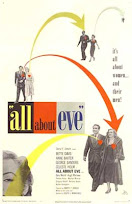
All About Eve (1950), is a realistic, dramatic depiction of show business and backstage life of Broadway and the New York theater. The devastating debunking of stage and theatrical characters was based on the short story and radio play The Wisdom of Eve by Mary Orr. A cinematic masterpiece and one of the all-time classic films, this award winner has flawless acting, directing, an intelligent script and believable characters. The film is driven by Mankiewicz' witty, cynical and bitchy screenplay - through the character of Addison DeWitt, Mankiewicz represented his point of view and opinions about show business. Thematically, it provides an insightful diatribe against crafty, aspiring, glib, autonomous female thespians who seek success and ambition at any cost without regard to scruples or feelings. The acclaimed film also comments on the fear of aging and loss of power/fame.

It was nominated for fourteen awards - more than any other picture in Oscar history, until Titanic (1997) duplicated the same feat forty-seven years later. The skillful film won six Oscars: Best Picture, Best Supporting Actor (George Sanders), Best Director (Joseph L. Mankiewicz), Best Screenplay (Joseph L. Mankiewicz), Best Sound Recording, and Best B/W Costume Design. Four actresses in the film were nominated (and all lost). It holds the record for the film with the most female acting nominees:

* Best Actress (two) - Bette Davis and Anne Baxter
* Best Supporting Actress (two) - Celeste Holm and Thelma Ritter

Bette Davis' leading (but not title) role as Margo Channing has generally been considered her greatest career performance and her most memorable, signature role. [Other choices for the role included Claudette Colbert, Gertrude Lawrence and Marlene Dietrich.] Her part as an aging, 40-year old Broadway actress fit the 42-year old Davis perfectly, at a time when acting roles were drying up for her. Davis played opposite co-star Gary Merrill - with whom she had an affair during filming, and soon married (it was her fourth - and last - marriage, that lasted from 1950-1960) after waiting for each other's divorce.

The film was adapted and transformed into a Broadway play called Applause in 1970, with Lauren Bacall (later replaced by Anne Baxter!) as Margo Channing. Eddie (Ed) Fisher's sole scene was cut from the final version, although he still received screen credit as Stage Manager. The film is often noted as a "three suicide movie," for the deaths of George Sanders, Marilyn Monroe (although it may have been an accidental overdose), and Barbara Bates.

The film opens with the image of an award trophy, described in voice-over by an off-camera, muted voice:

The Sarah Siddons Award for Distinguished Achievement is perhaps unknown to you. It has been spared the sensational and commercial publicity that attends such questionable 'honors' as the Pulitzer Prize - and those awards presented annually by that film society.

We are informed about the setting - where we are and why. The elite of the theatrical world attend the annual presentation of the enviable Sarah Siddons Award for dramatic achievement in the theatre:

This is the dining hall of the Sarah Siddons Society. The occasion is its annual banquet and presentation of the highest honor our theater knows - the Sarah Siddons Award for Distinguished Achievement...The minor awards, as you can see, have already been presented. Minor awards are for such as the writer and director [playwright Lloyd Richards and director Bill Sampson are briefly viewed] since their function is merely to construct a tower so that the world can applaud a light which flashes on top of it. And no brighter light has ever dazzled the eye than Eve Harrington. Eve. But more of Eve later, all about Eve, in fact.

The cynical, caustic, acid-tongued New York drama critic Addison De Witt (George Sanders) introduces himself before going further:

To those of you who do not read, attend the theater, listen to unsponsored radio programs or know anything of the world in which you live - it is perhaps necessary to introduce myself. My name is Addison De Witt. My native habitat is the theater. In it, I toil not, neither do I spin. I am a critic and commentator. I am essential to the theater.

The narrator, De Witt introduces (in voice-over) a number of other main characters in the ceremony's audience at the same table, including Karen Richards (Celeste Holm), wife of playwright Lloyd Richards (Hugh Marlowe):

She is the wife of a playwright, therefore of the theatre by marriage. Nothing in her background or breeding should have brought her any closer to the stage than Row E, Center. However, during her senior year at Radcliffe, Lloyd Richards lectured on the drama. The following year, Karen became Mrs. Lloyd Richards.

The next individual at the table to be introduced is Max Fabian (Gregory Ratoff), the theatrical producer of the play which has won the award for Eve:

There are in general two types of theatrical producers. One has a great many wealthier friends who will risk a tax deductible loss. This type is interested in art. The other is one to whom each production means potential ruin or fortune. This type is out to make a buck.

Finally, there is Broadway actress Margo Channing (Bette Davis):

Margo Channing is a Star of the Theater. She made her first stage appearance, at the age of four, in Midsummer Night's Dream. She played a fairy and entered - quite unexpectedly - stark naked. She has been a Star ever since. Margo is a great Star. A true star. She never was or will be anything less or anything else.

Miss Eve Harrington (Anne Baxter), an actress who we soon learn "all about" in flashback, is being honored as the youngest recipient ever to win the Sarah Siddons Award as Best Actress - "such a young lady, young in years, but whose heart is as old as the theater. Some of us are privileged to know her. We have seen beyond the beauty and artistry that have made her name resound through the nation." From the reactions of audience members who have been introduced - false smiles, unmoving faces, cynical looks, and unapplauding hands, one senses the sham of the awards ceremony for Eve:

We know her humility, her devotion, her loyalty to her art, her love, her deep and abiding love for us, for what we are and what we do, the theater. She has had one wish, one prayer, one dream - to belong to us. Tonight, her dream has come true. And henceforth, we shall dream the same of her.

As the glamorous Eve rises in a regal manner to triumphantly accept the award, the voice-over continues - as she reaches out for the award, the shot freeze-frames:

Eve. Eve the Golden Girl, the Cover Girl, the Girl Next Door, the Girl on the Moon. Time has been good to Eve. Life goes where she goes. She's the profiled, covered, revealed, reported. What she eats and what she wears and whom she knows and where she was, and when and where she's going. Eve. You all know All About Eve. What can there be to know that you don't know?

In the remainder of the film, events from early October to June which led to the award ceremony are unfolded through the thoughts and actions of each important character that is in attendance.

Karen Richards, the playwright's wife ("a lowest form of celebrity"), and Margo Channing's best friend, relates that Eve began her life in the theater as an innocent, forlorn, star-struck fan, haunting the theater where her idol appeared, watching every performance and waiting in the back alley to see her idol arrive and leave. She worships one of Broadway's mega-stars, actress Margo Channing, who is appearing in producer Max Fabian's play Aged in Wood - directed by the star's lover Bill Sampson (Gary Merrill). Eve ("another tongue-tied gushing fan") is given the opportunity to meet her idol backstage following an evening performance.

Inside the theatre, the starry-eyed, stage-struck girl wanders around: "You can breathe it, can't you? Like some magic perfume." In Margo's backstage dressing room, Karen is envious of Margo's theatrical success: "You're talented, famous, wealthy, people waiting around night after night, just to see you, even in the wind and the rain." But Margo doesn't think much of her fans and audience:

Autograph fiends, they're not people. Those are little beasts that run around in packs like coyotes...They're nobody's fans. They're juvenile delinquent, they're mental defective, and nobody's audience. They never see a play or a movie even. They're never indoors long enough.

Karen begs Margo to see one of her adoring "indoors" fans: "Oh, but you can't put her out. I promised. Margo, you've got to see her. She worships you. It's like something out of a book...You're her whole life." Eve, seen in the alley's shadows as "the mousy one with the trench coat and a funny hat," is ushered into the dressing room and introduced to Margo - with unflattering cold cream on her face. The young girl Eve responds passionately toward the play: "I've seen every performance...I'd like anything Miss Channing played in...I think that part of Miss Channing's greatness lies in her ability to pick the best plays."

In a classic scene, wet-eyed Eve uses her captivating, acting abilities to tell her dressing room audience the hard-luck, melancholy tale of her life story which began in Wisconsin as an only child. "But somehow, acting and make believe began to fill up my life more and more. It got so I couldn't tell the real from the unreal. Except that the unreal seemed more real to me."

Her father was a poor farmer, so to help out, she quit school, moved to Milwaukee, and became a secretary - in a brewery. "...it's pretty hard to make believe you are anyone else. Everything is beer." There was a little theatre group there - "like a drop of rain on the desert." Purportedly, she married Eddie, a radio technician, and during the war, he flew in the Air Force in the South Pacific. She learned she was a war widow when she was in San Francisco. Stranded, she remained there, found a job, and lived off her deceased husband's insurance. She saved herself from devastation by attending Margo's performances:

And there were theatres in San Francisco. And then one night, Margo Channing came to play in Remembrance and I went to see it. Well, here I am.

She had followed her acting idol from San Francisco across the country - with theatrical aspirations of her own to become a big star on Broadway. Eve's calculated, guileless manipulation of Margo's vanity and sentiments help her maneuver her way into Margo's life. Everyone is taken by lovely Eve's shy charm, helplessness, naivete, lack of pretention and passion. But Margo's maid, friend and companion Birdie Coonan (Thelma Ritter) reacts sarcastically and skeptically to Eve's fabricated, ingratiating "make-believe" image and stories:

What a story! Everything but the bloodhounds snappin' at her rear end.

Margo criticizes her maid for showing outspoken callousness toward Eve:

There are some human experiences, Birdie, that do not take place in a vaudeville house - and that even a fifth-rate vaudevillian should understand and respect!

Margo's fiancee-to-be, theatrical director Bill Sampson, a show business veteran and one of Margo's inner circle, is on his way to Hollywood for a month-long stay and a one-picture deal: "Zanuck is impatient. He wants me, he needs me." The earnest young woman Eve, who professes to admire Margo, quickly endears herself to the stage star, earning her a place in the star's inner circle. Margo encourages her to "stick around" for flattery's sake.

In flashback, Karen remembers that eventful evening: "And I'll never forget you, Eve." Sampson defines the word theater for Eve:

The theatuh, the theatuh - what book of rules says the theater exists only within some ugly buildings crowded into one square mile of New York City? Or London, Paris, or Vienna? Listen, junior. And learn. Want to know what the theater is? A flea circus. Also opera. Also rodeos, carnivals, ballets, Indian tribal dances, Punch and Judy, a one-man band - all theater. Wherever there's magic and make-believe and an audience - there's theater. Donald Duck, Ibsen, and the Lone Ranger. Sarah Bernhardt and Poodles Hanneford, Lunt and Fontanne, Betty Grable, Rex the Wild Horse, Eleanora Duse - they're all theater. You don't understand them, you don't like them all - why should you? The theater's for everybody - you included, but not exclusively - so don't approve or disapprove. It may not be your theater, but it's theater for somebody, somewhere...It's just that there's so much bourgeois in this ivory greenroom they call the theater. Sometimes it gets up around my chin.


If you are interested to read the completed article, please visit http://www.filmsite.org/alla.html
---------------------------------------------------------------
Greatest Films (www.filmsite.org and www.greatestfilms.org)
With descriptive review commentaries and background history on many classic, landmark films in cinematic history, especially American/Hollywood films. Including posters, Academy Awards history, film genres, film terms, film history by decade, trivia, and lots of lists of 'best' films, stars, scenes, quotes, resources, etc.

top

eXTReMe Tracker